 ©Hochschule Mainz
Home & Office?
Hochschule Mainz, University of Applied Sciences
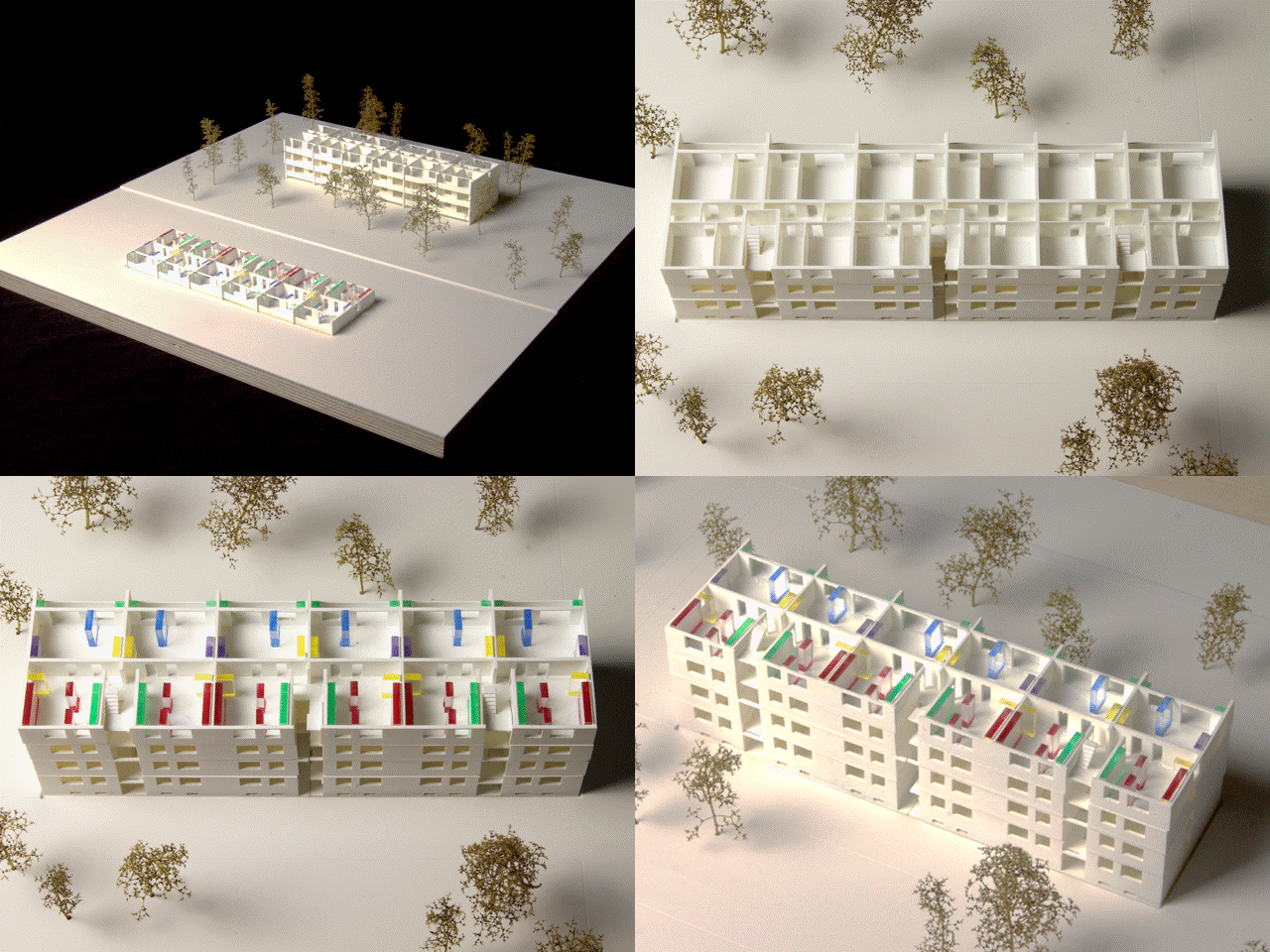
Post-war flats (1950–1970) are often outdated and no longer meet today's living and sustainability standards. However, it is important that they are adapted because there are still a large number of them in Germany. The research project is investigating how inexpensive modifications can increase the energy efficiency of flats and make them suitable for home offices and care facilities.
To this end, a prototype system is being designed that will be integrated into the interior and equipped with modern building technology. The measures are intended to adapt the flats to current needs and improve their economic and energy performance.
The findings of the research project can be found in the article “Upcycle post-WWII housing in Germany, case study: prototype design in Frankfurt-Mainz Region” (in English by Pelegrín Rodríguez, Marta, Prof. Dr., Mainz University of Architecture; Pérez Blanco, Fernando, M.Sc., Arch, University of Seville, 2025).
Abstract:
This article examines postwar social housing rehabilitation in Germany, where current policies primarily address construction quality and energy efficiency. Beyond these technical concerns, the research emphasizes the need to reconsider the inherited domestic spaces and programs of the Siedlungen. Despite their architectural, social, and urban value, nearly a third of these estates face not only physical and energetic deficiencies but also programmatic obsolescence and limited adaptability, hindering alternative forms of dwelling. Minor projects and small-scale interventions can act as catalysts for new spatial practices, as advocated by Eleb and Bendimerad, and Avermaete and van den Heuvel, challenging the typological and urban rigidity of the modernist legacy. Within this framework, the article explores an experimental design strategy in postwar estates by Ernst May’s office in the Rhine-Main region. Coordinated interventions by professionals, associations, and administrations may enable emancipatory processes, fostering collective reconfiguration of housing through simple spatial tools.
Initiator: Hochschule Mainz Architektur Institut. bim.labor. Prof. Dr. Marta Pelegrín.
ETS Arquitectura Sevilla/Madrid. Forschung Labor Nachkriegsmoderne, Frankfurt University of Applied Sciences.
Cooperation Wohnbau Amt Mainz und RheinMain-Gebiet.