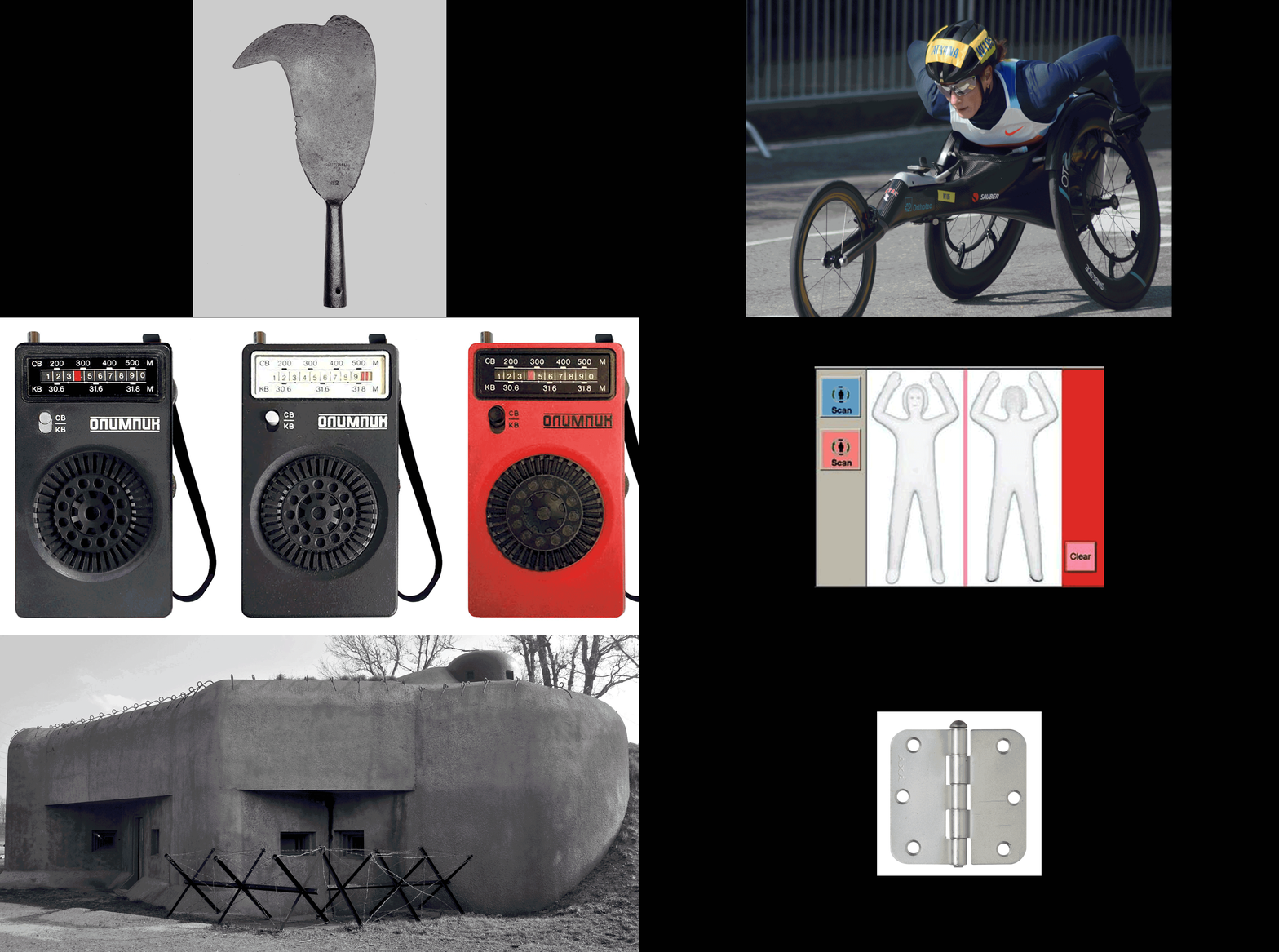
 ©Roberto Fortuna / Sugar cane knife, 1800s, Danish West Indies/ Nationalmuseet / CC BY-SA 2.0 Joe Haupt / Vintage RCA "AA" Transistor Radio Battery / CC BY-SA 2.0 Arend041 / Scharnier lossepen001 / GNU Free Documentation License young shanahan / Bunker B-S 4 Lány / CC BY-SA 2.0 Unknown author / Body image scanner avatar / CC 0 El nomad / Portable radio Olympic, by Mykola Lebid / CC 0 Gr5/ Tatyana McFadden 2025 / CC 0 Seabee314 / Iron Glaze Teapot With Bamboo Handle / CC 0 Gift of H. O. Havemeyer, 1896 / Vase MET DT190 / Tiffany / CC 0
Positions on Freedom. Gestaltung und ihre Grenzen – the thing Fellowship 2026
Eröffnung
the thing
...
Between aesthetics and norms, designers create concrete objects—such as tools, mobility concepts, or fashion—and in doing so, determine what appears possible. In this process, not only solutions emerge, but often also exclusions and new forms of normality. Through a wide range of works and formats, Positions on Freedom (Positionen zur Freiheit) approaches the concept of freedom from diverse perspectives. What emerges is a multi-layered concept that can only be grasped, if at all, in its sheer diversity.
The projects gathered in the exhibition range from political and spatial freedom to questions of artistic freedom and freedom of thought. They make freedom concrete in the form of barriers, representations of identity, and through engagements with violence and surveillance.
A central observation runs through the exhibition: freedom is ambivalent. It can only be understood in relation to its boundaries and limitations, whether these are of a spatial, social, or individual nature. Design makes these tensions visible and tangible, as well as the impacts of a lack of freedom.
Even though the exhibition maintains a consciously open approach to the concept of freedom, it follows a curatorial stance that does not conceive of freedom as the assertion of the strongest, but rather as a concept based on universal human rights and empathetic coexistence—between human beings as well as in our relationship to the planet we inhabit.
The exhibition is an official project in the context of World Design Capital 2026 and was realized as part of the thing Fellowship, an initiative of the thing Magazine. Created in partnership with USM and the Fondation USM, the show illuminates how substantive freedom can be negotiated within the tension between institutional structures and entrepreneurial action.
Anton Rahlwes is the initiator and artistic director of the project. Furthermore, designers Anton and Lotti Defant have designed the scenography as an additional "position on freedom" based on the metaphor of a "building of thought" (Gedankengebäude). The visual communication was created by Autostrada Studios. Both are integral and independent contributions to the substantive exploration of freedom.
The project was initiated by the designer, curator, and journalist Anton Rahlwes and is linked to the platform he founded, the thing Magazine. The project builds a bridge between production, design practice, and social impact. Its goal is to develop new perspectives on this complex of themes.
Within this framework, the company USM acts as a supporter of a free, substantive exploration. As a long-standing company that stands for longevity as well as flexibility, USM views its commitment as a contribution to the design discourse within the tension between production and culture—without imposing any content-related requirements.
Related Events
©Roberto Fortuna / Sugar cane knife, 1800s, Danish West Indies/ Nationalmuseet / CC BY-SA 2.0 Joe Haupt / Vintage RCA "AA" Transistor Radio Battery / CC BY-SA 2.0 Arend041 / Scharnier lossepen001 / GNU Free Documentation License young shanahan / Bunker B-S 4 Lány / CC BY-SA 2.0 Unknown author / Body image scanner avatar / CC 0 El nomad / Portable radio Olympic, by Mykola Lebid / CC 0 Gr5/ Tatyana McFadden 2025 / CC 0 Seabee314 / Iron Glaze Teapot With Bamboo Handle / CC 0 Gift of H. O. Havemeyer, 1896 / Vase MET DT190 / Tiffany / CC 0