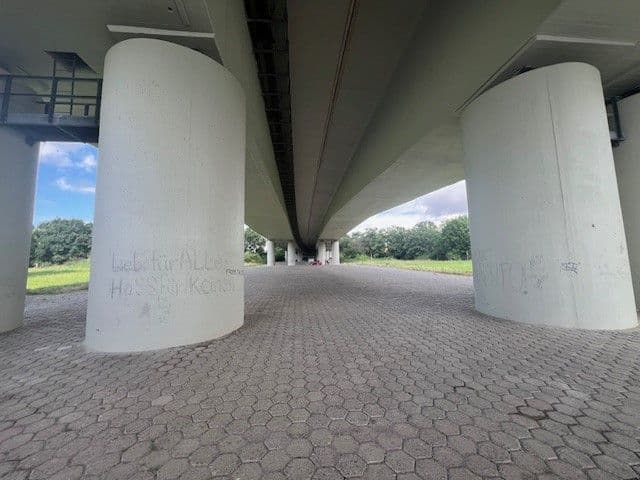
 ©Kulturamt Stadt Flörsheim
Streetart an der Opelbrücke
Kulturamt Stadt Flörsheim
...
Bridges serve to connect. Developed architecturally and historically in ancient times, bridges, consisting of a series of round arches, usually spanned watercourses or valleys. They were thus part of the logistical infrastructure. Built (mostly) of stone in ancient times and more often of wood in the Middle Ages, bridges underwent a transformation as a transport element in the late 19th century.
Although their main purpose was still to ensure passability over water, etc., the appearance (design) of bridges became increasingly important. Due to the new building materials steel and concrete, the appearance of bridges, especially the piers/pylons, became increasingly slender. What previously had to look strong, stable and trustworthy (Hohenzollern Bridge in Cologne) became increasingly refined and graceful (Öresund Bridge) in the course of the 20th century. The spirit of the times and thus the design had changed.
But regardless of the time period, the term ‘bridge’ immediately conjured up images of pillars and supporting structures, but rarely the architectural situation beneath the bridge or roadway. In the 20th century, this place ‘under the bridge’ was associated with people on the margins of society and social decline. Homeless people and criminals lived ‘under the bridge’.
With the emergence of street art in the 1980s, particularly in the USA, attitudes towards this location gradually changed. Members of this ‘subculture’ such as Keith Haring found creative freedom in the walls of bridge abutments and the foundations of bridge piers. It took some time for street art to gain social recognition as an art form and find its way into art galleries.
In 2026, such a (non-)place in Flörsheim will be enhanced by street art. The connecting path between Flörsheim and Rüsselheim will be redesigned in terms of colour and content in a collaborative project. The pillars are between 15 and 3 metres high and have a circumference of approximately 6 metres. The lower area up to a height of 2.50 metres will be designed in a youth project together with a professional artist. The area above 2.50 metres is reserved for professionals.
During summer workshops under the bridge, the young people will learn the technique of spray art and gain an insight into the lifestyles of professional artists/workshop leaders. The youth projects focus on creating art together and getting to know each other. In addition to enhancing the location. The overall project also aims to create an opportunity for tourist marketing, keyword street art gallery.