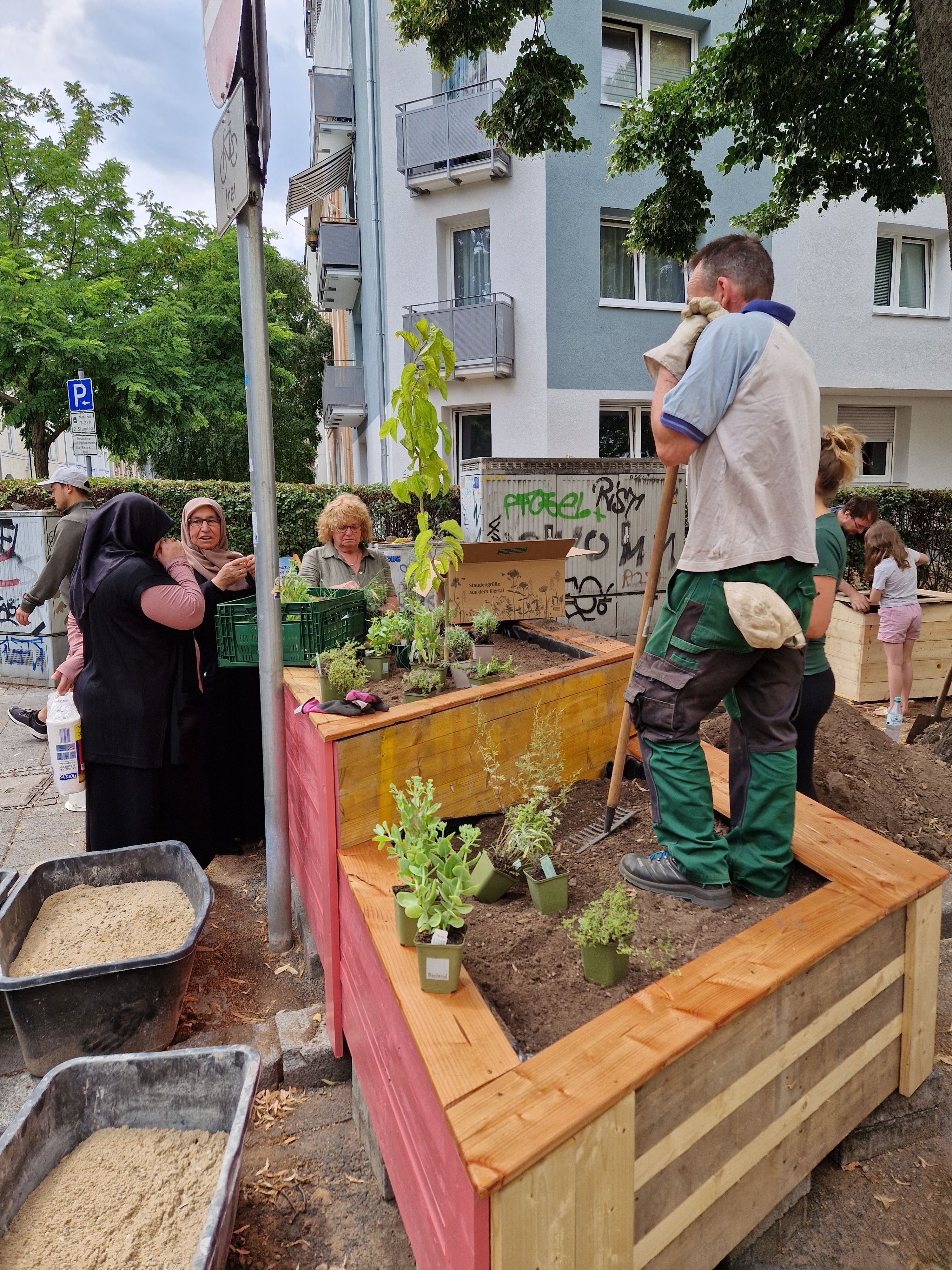
 ©Janina Albrecht
Mini-Park am Fahrbahnrand
Janina Albrecht
A mini-park (or pocket park) requires a space of at least 2 x 6 meters in public areas – for example, the surface of two curbside parking spaces or an adjacent green strip.
The idea is to activate a sealed or neglected site where there is little greenery and no non-commercial seating. At such a location, questions, ideas, wishes, and concerns of neighbors are gathered in a visible, low-threshold, and ongoing process. These inputs shape a concrete design, which is then renegotiated on-site, “approved” by the community, and finally submitted to the city administration for authorization. Afterwards, steps such as detailing, construction planning, material acquisition, and invitations to building, painting, or planting workshops follow – depending on what is to be realized on-site. The mini-park is then built collaboratively over several days; in the case of larger projects, construction is carried out in stages. Finally, the park is inaugurated with a celebration. People with different backgrounds, skills, and interests are invited to participate, meet one another, experience self-efficacy, and take on shared responsibility.