 ©Sammlung des Centre Georges Pompidou
Museum Angewandte Kunst, Frankfurt
Im Modus der Serie. Differenz, Variation und Wiederholung in Architektur und Design
October 2026
Museum Angewandte Kunst Frankfurt am Main
...
Series open up a play of nuances and differences, of redundancies and repetitions. Any series, once begun, can be expanded with similar objects. Objects conceived, produced, received, or consumed in the mode of seriality always refer to related items within the same series. But what exactly makes a series a series? What significance does seriality hold for the design of our everyday environments, and at which points does the series allow for individual customization? The exhibition In the Mode of the Series: Difference, Variation, and Repetition in Architecture and Design aims to offer new approaches to the field of seriality. It examines serial strategies and processes to highlight both the potentials and the limitations of seriality.
The exhibition makes central aspects of seriality accessible and sensory, while also addressing the local context of the city of Frankfurt. From a historical perspective, it explores the development of serial production in New Frankfurt (Das Neue Frankfurt) since the 1920s. From a contemporary perspective, it is part of an extensive program of events for the World Design Capital Frankfurt RheinMain 2026.
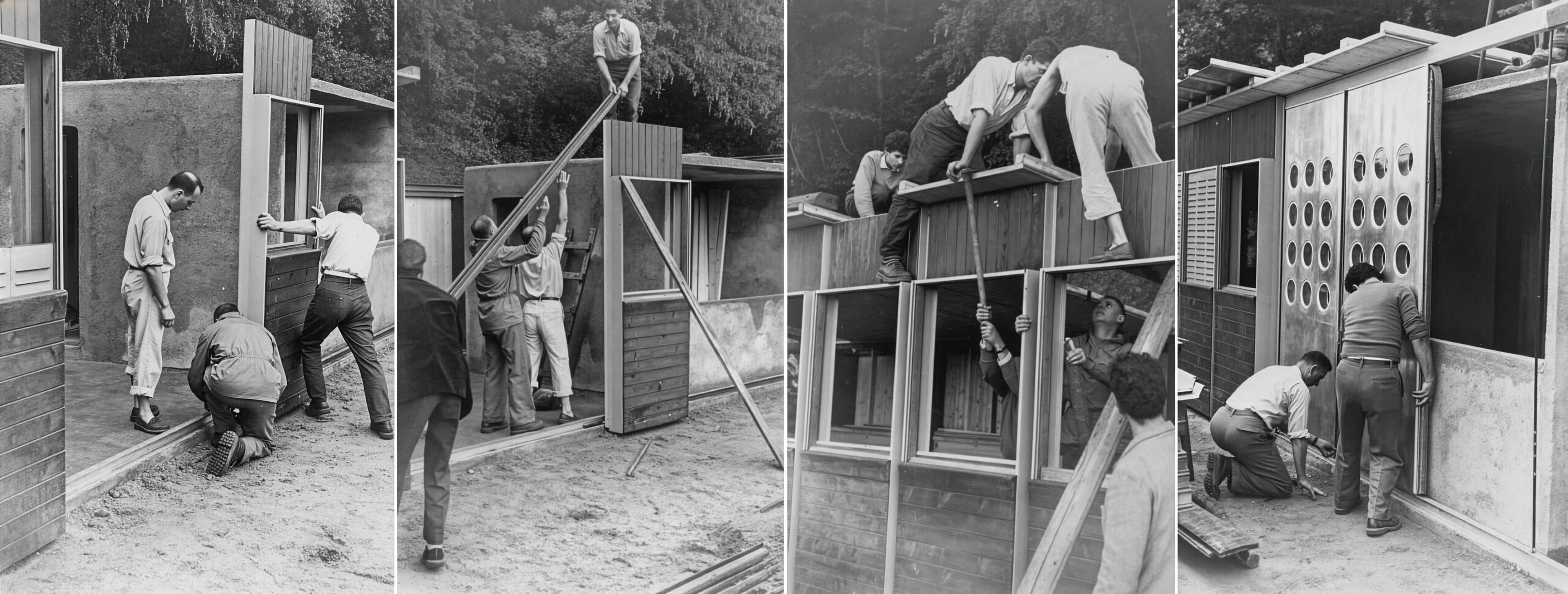
The exhibition provides a historical overview of seriality, whose potential has unfolded across the scales of the city, the architectural object, and building components. While 20 case studies of outstanding examples in construction are made accessible to the public through images, plans, and models, seven studies demonstrate how the theme is addressed in the fields of product, communication, and interior design. Visitors can thus discover, on one hand, inventions, product innovations, and manufacturing processes that trace lines of development in the history of technology, and, on the other hand, contemporary critical discourse in the field of design.
Today, we encounter the concept of seriality once again as a political promise. As the current debate on housing construction shows, seriality is expected to accelerate manufacturing processes, simplify procedures, and curb costs. Seriality is meant to provide sustainable building components in high volumes. Models, modules, and prototypes are already lined up. When will they go into mass production? Before production is ramped up, we want to pause and ask: what exactly is meant by this new appeal to seriality? What does seriality mean with regard to ethical and aesthetic questions? To provide space for these and other questions, the Frankfurt-based foundation urban future forum e.V.—as the initiator and conceptual creator of the exhibition—invites you to three accompanying lecture and discussion events: the Parliaments of Series (Serienparlamente). Each of these parliaments is dedicated to an overarching theme, inviting architects, designers, manufacturers, politicians, and citizens to present their thoughts and positions on serial planning and production, and to discuss them with the audience. The goal is to show how the (supposed) contradiction between serial design and good design can be resolved, and to demonstrate through concrete examples that quality is indeed compatible with the means of industrial manufacturing.
The exhibition is curated by Prof. Axel Sowa, supported by Florian Eschner, the team from the Chair of Architectural Theory, and students from RWTH Aachen University. It is being developed in collaboration with students from HfG Offenbach under the direction of Prof. Matthias Wagner K. Prof. Norbert Hanenberg contributed to the design of the exhibition furniture together with students from TH Gießen.
The exhibition is funded by the Wüstenrot Foundation, the Else Kröner Fresenius Foundation, the Informationszentrum Beton, B&O Bau GmbH, and RWTH Aachen University.